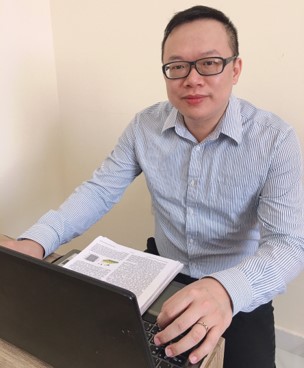
Lu, Chun-Yu (Jin-You)
Computational Physicist | Electromagnetics and Multiphysics
Abu Dhabi, UAE
BS (NTNU-Physics), PhD (NTU-Physics)





I am a computational physicist with a strong interest in turning physical models into practical simulation workflows. My work spans first-principles calculations, computational electromagnetics, and multiphysics structural modeling for heterogeneous and multiscale systems.
I am particularly interested in combining analytical modeling, numerical simulation, and experimental measurements to relate material-level mechanisms to measurable device and structural behavior.
Recent Highlights


Recent News
- Nov 17–20, 2025: Keynote Speaker (Industrial Forum), “Accelerating Innovation in Advanced Materials” Summit, Abu Dhabi, UAE
- 2025: Technical Program Committee Member (SC2: Metamaterials, Plasmonics and Complex Media), PIERS 2025, Abu Dhabi, UAE (Organization)
- 2019: Won the IEEE Nanotechnology Council NMDC Best Poster Award
- 2017: Research highlighted in The National (PDF)
- 2016: Research highlighted in MIT News (PDF)
Recent Talks
- "Density Functional Theory Simulation in Material Science," Invited Talk, Summer Lecture, National Taipei University of Technology, July, 2019
- "Use of Density Functional Theory in the Design and Fabrication of Materials," Invited Talk, PhD Seminar, Khalifa University, December, 2018
- "In Depth Wettability Nano Scale Investigation: Interesting Carbonate Case Study in Society of Petroleum Engineers," Invited Talk, ESG monthly meeting, December 2017
Selected Research Areas
These selected research areas highlight the physical problems, modeling approaches, and representative systems that connect my work in first-principles simulation, multiscale materials modeling, optics, and multiphysics analysis.
2D Materials Studies
This work combines local probe measurements and first-principles analysis to study graphene-coated interfaces and other low-dimensional material systems. The emphasis is on how interfacial structure and surface energetics influence measurable behavior, which is directly relevant to functional heterostructures, surface engineering, and materials characterization. The related work has been published in Nanoscale, which could be accessed here.
The figure below compares local surface-energy behavior for graphene-coated substrates prepared by different routes.

Surface Wettability Studies
This research develops first-principles routes for predicting wettability, adhesion, and interfacial energetics in solid–liquid and multiphase systems. It connects atomistic calculations to engineering observables such as contact angle and spreading behavior, and is relevant to surface design, interfacial materials, and physics-based materials screening. The related work has been published in Journal of Physical Chemistry Letters, which could be accessed here.
The figure below illustrates an atomistic workflow for predicting macroscopic wetting behavior from surface-specific calculations.

Interfacial Solar Vapor Generators
This work combines device design, thermal transport analysis, and multiphysics simulation to understand interfacial solar vapor generation under realistic operating conditions. It reflects a broader interest in linking material properties, heat transfer, and system-level performance in engineered energy devices. The related work has been published in Joule, which could be accessed here.
The figure below compares measured and simulated temperature fields for the vapor generator under different illumination conditions.

Plasmonic Nanocomposite Solar Absorbers
This research uses electromagnetic simulation, nanocomposite design, and experiment to develop broadband optical absorbers with scalable thin-film architectures. The work sits at the interface of photonic materials engineering and structure–property design, and is closely aligned with computationally guided materials discovery for functional coatings and optical materials. The related work has been published in Advanced Optical Materials, which could be accessed here.
The figure below shows how embedded metallic nanoparticles strengthen light–matter interaction in nanocomposite absorber films.

Plasmon-Enhanced Nanoporous Absorbers
This work focuses on wave-based design of ultrathin absorbing structures by combining thin-film interference with localized plasmonic effects. It highlights a physics-driven route for engineering optical response through geometry, materials selection, and simulation, which aligns well with advanced materials design and device-oriented computational research. The related work has been published in Advanced Optical Materials, which could be accessed here.
The figure below illustrates an ultrathin broadband absorber in which pore-shaped metallic features activate localized plasmonic enhancement.

Highlight Publications
- S. R. Tamalampudi,J.-Y. Lu*, N. Rajput, C. Y. Lai, B. Alfakes, R. Sankar, ... & M. Chiesa*, "Superposition of Semiconductor and Semi-metal Properties of Self-assembled 2D SnTiS3 Heterostructures," npj 2D Materials and Applications, vol. 4, no. 23, July. 2020 (IF ~ 9.324)
- J.-Y. Lu, Q. Ge, A. Raza, and T. J. Zhang*, "Quantum Mechanical Prediction of Wettability of Multiphase Fluids–Solid Systems at Elevated Temperature," Journal of Physical Chemistry C, vol. 123, no. 20, pp. 12753-12761, May. 2019 (IF ~ 4.309)(highlighted in Emirates News)
- J.-Y. Lu, T. A. Olukan, S. R. Tamalampudi, A. Al-Hagri, C.-Y. Lai, M. A. Almahri, H. Apostoleris, I. Almansouri, and M. Chiesa*, "Insights into Graphene Wettability Transparency by Locally Probing its Surface Free Energy," Nanoscale, 11, pp. 7944-7951, Mar. 2019 (IF ~ 6.98)
- X. Q. Li, J. L. Li, J.-Y. Lu, N. Xu, C. L. Chen, X. Z. Min, B. Zhu, H. X. Li, L. Zhou, S. N. Zhu, T. J. Zhang, and J. Zhu*, "Enhancement of Interfacial Solar Vapor Generation by Environmental Energy," Joule, vol. 2, no. 7, pp. 1331-1338, Jul. 2018 (IF ~ 15.04)
- J.-Y. Lu, Q. Ge, H. Li, A. Raza, and T. J. Zhang*, "Direct Prediction of Calcite Surface Wettability with First-Principles Quantum Simulation," Journal of Physical Chemistry Letters, vol. 8, no. 21, pp. 5309-5316, Oct. 2017 (IF ~ 7.33)(highlighted in Emirates News)
- J.-Y. Lu, A. Raza, S. Noorulla, Afra S. Alketbi, N. X. Fang, G. Chen, and T. J. Zhang*, "Near-Perfect Ultrathin Nanocomposite Absorber with Self-Formed Topping Plasmonic Nanoparticles," Advanced Optical Materials, 5, 1700222, Jul. 2017 (IF ~ 7.12)(highted in UAE News)
- J.-Y. Lu, S. H. Nam, K. Wilke, A. Raza, Y. K. Lee, A. A. Ghaferi, N. X. Fang, and T. J. Zhang*, "Localized Surface Plasmon Enhanced Ultrathin Film Broad-Band Nanoporous Absorbers," Advanced Optical Materials, vol. 4, no. 8, pp. 1255-1264, May 2016 (IF ~ 7.12)(highlighted in MIT News)
The following are the full list of publications
Click to expand
Journal Papers
- B. Alfakes, J. E. Villegas, H. Apostoleris, R. S. Devarapalli, S. R. Tamalampudi, J.-Y. Lu, J. Viegas, I. Almansouri, and M. Chiesa, "Optoelectronic Tunability of Hf Doped ZnO for Photovoltaic Applications," Journal of Physical Chemistry C, vol. 123, no. 24, pp. 15258-15266, May 2019
- A. Al-Hagri, R. Li, N. S. Rajput, J.-Y. Lu, S. C., K. Sloyan, M. A. Almahri, S. R. Tamalampudi, M. Chiesa, and A. A. Ghaferi, "Direct growth of single-layer terminated vertical graphene array on germanium by plasma-enhanced chemical vapor deposition," Carbon, vol. 155, pp. 320-325, Dec. 2019
- J.-Y. Lu, Q. Ge, A. Raza, and T. J. Zhang, "Quantum Mechanical Prediction of Wettability of Multiphase Fluids-Solid Systems at Elevated Temperature," Journal of Physical Chemistry C, vol. 123, no. 20, pp. 12753-12761, May 2019 (highlighted in KU Times)
- S. R. Tamalampudi, R. Sankar, H. Apostoleris, M. A. AlMahri, B. Alfakes, A. Al-Hagri, R. Li, A. Gougam, I. Almansouri, M. Chiesa, and J.-Y. Lu*, "Thickness-Dependent Resonant Raman and E Photoluminescence Spectra of Indium Selenide and Indium Selenide\Graphene Heterostructures," Journal of Physical Chemistry C, vol. 123, no. 24, pp. 15345-15353, May 2019.
- Md. M. Rahman, A. Raza, H. Younes, A. AlGhaferi, M. Chiesa, and J.-Y. Lu*, "Hybrid graphene metasurface for near-infrared absorbers," Optics Express, vol. 27, no. 18, pp. 24866-24876, 2019
- S. R. Tamalampudi, S. Patole, B. Alfakes, R. Sankar, I. Almansouri, M. Chiesa, and J.-Y. Lu*, "High Temperature Defect-Induced Hopping Conduction in Multi-Layered Germanium Sulfide for Optoelectronics Applications in Harsh Environments," ACS Applied Nano Materials, vol. 2, no. 4, pp. 2169-2175, Mar. 2019.
- J.-Y. Lu, T. A. Olukan, S. R. Tamalampudi, A. Al-Hagri, C.-Y. Lai, M. A. Almahri, H. Apostoleris, I. Almansouri, and M. Chiesa, "Insights into Graphene Wettability Transparency by Locally Probing its Surface Free Energy," Nanoscale, 11, pp. 7944-7951, Mar. 2019
- Afra S. Alketbi, B. Yang, A. Raza, M. Zhang, J.-Y. Lu, Z. Wang, and T. J. Zhang, "Sputtered SiC coatings for radiative cooling and light absorption," Journal of Photonics for Energy, 9(3), 032703, Dec. 2018
- K. Sloyan, C.-Y. Lai, J.-Y. Lu, B. Alfakes, S. A. Hassan, I. Almansouri, M. S. Dahlem, and M. Chiesa, "Discerning the Contribution of Morphology and Chemistry in Wettability Studies," The Journal of Physical Chemistry A, vol. 122, no. 38, pp. 7768-7773, Jul. 2018
- Y.-C. Chiou, T. A. Olukan, M. A. Almahri, H. Apostoleris, C.-H. Chiu, C.-Y. Lai, J.-Y. Lu, S. Santos, I. Almansouri, and M. Chiesa, "Direct Measurement of the Magnitude of van der Waals interaction of Single and Multilayer Graphene," Langmuir, vol. 34, no. 41, pp. 12335-12343, Sep. 2018
- J.-Y. Lu, C.-Y. Lai, I. Almansour, and M. Chiesa, "The evolution in graphitic surface wettability with first-principles quantum simulations: the counterintuitive role of water," Physical Chemistry Chemical Physics, 20, pp. 22636-22644, 2018
- X. Q. Li, J. L. Li, J.-Y. Lu, N. Xu, C. L. Chen, X. Z. Min, B. Zhu, H. X. Li, L. Zhou, S. N. Zhu, T. J. Zhang, and J. Zhu, "Enhancement of Interfacial Solar Vapor Generation by Environmental Energy," Joule, vol. 2, no. 7, pp. 1331-1338, Jul. 2018
- A. Raza, J.-Y. Lu, S. Alzaim, H. Li, and T. J. Zhang, "Novel Receiver-Enhanced Solar Vapor Generation: Review and Perspectives," Energies, vol. 11, no. 1, pp. 253, Jan. 2018 (Invited review)
- J.-Y. Lu, Q. Ge, H. Li, A. Raza, and T. J. Zhang, "Direct Prediction of Calcite Surface Wettability with First-Principles Quantum Simulation," Journal of Physical Chemistry Letters, vol. 8, no. 21, pp. 5309-5316, Oct. 2017
- J.-Y. Lu, A. Raza, S. Noorulla, Afra S. Alketbi, N. X. Fang, G. Chen, and T. J. Zhang, "Near-Perfect Ultrathin Nanocomposite Absorber with Self-Formed Topping Plasmonic Nanoparticles," Advanced Optical Materials, 5, 1700222, Jul. 2017
- J.-Y. Lu, A. Raza, N. X. Fang, G. Chen, and T. J. Zhang, "Effective dielectric constants and spectral density analysis of plasmonic nanocomposites," Journal of Applied Physics, vol. 120, no. 16, 163103, Oct. 2016
- Md. M. Rahman, H. Younes, J.-Y. Lu, G. W. Ni, S. J. Yuan, N. X. Fang, T. J. Zhang, and A. AlGhaferi, "Broadband Light Absorption by Silver Nanoparticles Decorated Silica Nanospheres," RSC Advance, 6, pp. 107951-107959, Nov. 2016
- J.-Y. Lu, S. H. Nam, K. Wilke, A. Raza, Y. K. Lee, A. A. Ghaferi, N. X. Fang, and T. J. Zhang, "Localized Surface Plasmon Enhanced Ultrathin Film Broad-Band Nanoporous Absorbers," Advanced Optical Materials, vol. 4, no. 8, pp. 1255-1264, May 2016
- H. R. Liu, A. Raza, A. Aili, J.-Y. Lu, A. AlGhaferi, and T. J. Zhang, "Sunlight-Sensitive Anti-Fouling Nanostructured TiO2 coated Cu Meshes for Ultrafast Oily Water Treatment," Scientific Reports, 6, 25414, May 2016
- Y. W. Lin, W. J. Chen, J.-Y. Lu, Y. H. Chang, C. T. Liang, Y. F. Chen, and J. Y. Lu, "Growth and characterization of ZnO/ZnTe core/shell nanowire arrays on transparent conducting oxide glass substrates," Nanoscale Research Letters, 7:401, Jul. 2012
- J.-Y. Lu, H. Y. Chao, J. C. Wu, S. Y. Wei, and Y. H. Chang, "Metallic-shell nanocylinder arrays for surface-enhanced spectroscopies," Nanoscale Research Letters, 6:173, Feb. 2011
- H. Y. Chao, S. H. You, J. Y. Lu, J. H. Cheng, Y. H. Chang, and C. T. Wu, "The growth and characterization of ZnO/ZnTe core-shell nanowires and the electrical properties of ZnO/ZnTe core-shell nanowires field-effect transistor," Journal of Nanoscience and Nanotechnology, vol. 11, no. 3, pp. 2042-2046, Mar. 2011
- J.-Y. Lu and Y. H. Chang, "The lightening-rod mode in a core-shell nanocylinder dimer," Optics Communications, vol. 283, no. 12, pp. 2627-2630, Jun. 2010
- J.-Y. Lu, H. Y. Chao, J. C. Wu, S. Y. Wei, Y. H. Chang, and S. C. Chen, "Retardation-induced plasmon modes in silica-core gold-shell nanocylinder pair," Physica E, 42, pp. 2583-2587, Sep. 2010
- J.-Y. Lu and Y. H. Chang, "Implementation of an efficient dielectric function into the finite difference time domain method for simulating the coupling between localized surface plasmons of nanostructures," Superlattices and Microstructures, vol. 47, no. 1, pp. 60-65, Jan. 2010
- H. Y. Chao, J. H. Cheng, J.-Y. Lu, Y. H. Chang, C. L. Cheng, Y. F. Chen, and C. T. Wu, "Growth and characterization of type-II ZnO/ZnTe core-shell nanowire arrays for solar cell applications," Superlattices and Microstructures, vol. 47, no. 1, pp. 160-164, Jan. 2010
- J.-Y. Lu and Y. H. Chang, "Optical singularities associated with the energy flow of two closely spaced core-shell nanocylinders, Optics Communications," Optics Express, vol. 17, no. 22, pp. 19451-19458, 2009
Conference Presentations
- J.-Y. Lu, Md. M. Rahman, and M. Chiesa, "Amorphous Graphene-Based Plasmonic Metasurface for Near-Infrared Absorbers," American Physical Society, Apr. 16-19, 2019, Denver, USA
- J.-Y. Lu, C.-Y. Lai, M. A. Almahri, T. Olukan, H. Apostoleris, I. Almansouri, and M. Chiesa, "Prediction of Surface Wettability of Fresh and Aged Graphite Surfaces from First-Principles Density Functional Theory Simulations," Material Research Society Fall, Nov. 25-30, 2018, USA
- J.-Y. Lu, S. Noorulla, N. X. Fang, and T. J. Zhang, "Design of Broadband Ultrathin Film Nanoporous Solar Absorbers," Micro/Nanoscale Heat & Mass Transfer International Conference, Jan. 1-4, 2016, Biopolis, Singapore
- J.-Y. Lu, A. Raza, N. X. Fang, G. Chen, and T. J. Zhang, "Optical Characterizations of Plasmonic Nanocomposites," The 8th Annual International Workshop on Advanced Materials, Feb. 21-23, 2016, Ras Al Khamiah, UAE
- S. Noorulla, J.-Y. Lu, S. H. Nam, N. X. Fang, and T. J. Zhang, "Plasmon-Enhanced Solar Absorbers," The 8th Annual International Workshop on Advanced Materials, Feb. 21-23, 2016, Ras Al Khamiah, UAE
- A. Alketbi, J.-Y. Lu, and T. J. Zhang, "Design and Performance of Passive Radiative Cooler under Direct Sunlight," The Graduate Students Research Conference, Mar. 20-22, 2016, Al Ain, UAE
- S. Noorulla, J.-Y. Lu, A. Raza, and T. J. Zhang, "Near Perfect Broadband Absorber Based on Random Metal Nanoparticles with Varied Spacer layers," The Graduate Students Research Conference, Mar. 20-22, 2016, Al Ain, UAE
- J.-Y. Lu, D. Liu, K. Wilke, S. Noorulla, N. X. Fang, and T. J. Zhang, "Plasmon-Enhanced Ultrathin Film Broad-Band Nanoporous Absorber," American Physics meeting (ASP), Mar. 2-6, 2015, San Antonio, USA
- J.-Y. Lu, and Y. H. Chang, "," The 14th International Conference on Modulated Semiconductor structures (MSS-14), 2011, Florida, USA
- J.-Y. Lu, H. Y. Chou, J. C. Wu, S. Y. Wei, and Y. H. Chang, "," The 16th International Conference on Superlattices, Nanostructures and Nanodevices, 2010, Beijing, China
- J.-Y. Lu and Y. H. Chang, "," The 9th International Conference on Physics of Light-Matter Coupling in Nanostructures, 2009, Leece, Italy
Research Notes
These notes sit between the publication list and the teaching modules. They emphasize how physical models are formulated, validated, and translated into defensible computational workflows for materials, devices, and engineered structures.
Effective Medium Theory and Composite Response
Notes on homogenization, Maxwell–Garnett theory, Bergman spectral representation, and the interpretation of microstructure-dependent effective response in heterogeneous media.
This stream also includes revisiting classical formulations beyond the basic dipolar Maxwell–Garnett limit, including PRB 1992-type treatments of interaction effects, spectral response, and the physically meaningful reconstruction of published composite-medium results.
First-Principles Modeling and Materials Discovery
Notes on DFT-based workflows, descriptor selection, structure–property mapping, and physically grounded strategies for computational materials screening and accelerated materials discovery.
Physics-Guided AI and Inverse Design
Methodological notes on combining simulation, optimization, and machine-learning-assisted search for functional materials and engineered structures, with emphasis on interpretable design logic rather than black-box prediction alone.
Multiphysics Modeling for Functional Materials and Structures
Notes linking analytical models, finite element simulation, and engineering observables across structural, thermal, electromagnetic, and heterogeneous material systems, with attention to scale bridging and physically meaningful performance metrics.
Validation, Benchmarking, and Physical Interpretation
Notes on model validation, convergence assessment, analytical benchmarking, code verification, and physics-based interpretation across electromagnetic, mechanical, and atomistic simulation workflows.
Optical material models
FDTD Optical Material Database
This section provides a searchable database of compact optical material models for time-domain electromagnetic simulation. The current visible–near-IR release is organized around complex-conjugate pole-residue rational-pole models (CCPR/RP) and critical-point (CP) extensions of the same pole-residue framework.
RP provides the general complex pole-residue representation, while CP introduces critical-point-inspired structure for optical spectra with interband-like features. In both cases, the final fitted parameters are exported as PoleResidue JSON files following the Tidy3D-compatible file convention for easy implementation and are used directly by the centered-ADE FDTD update.
Model representation
In the Tidy3D-compatible PoleResidue convention used by the exported JSON files, the CCPR/RP model is evaluated under the exp(−iωt) time convention as
The complex-conjugate pairing gives a real time-domain response. The pole am and residue cm are the parameters stored in the JSON file; passive poles have negative real parts and should not be sign-flipped before use in the centered-ADE FDTD update.
The CP model is used as a positive-frequency critical-point fitting ansatz for interband-like optical features,
Here Ωℓ, Γℓ, Aℓ, φℓ, and pℓ denote the critical-point energy, broadening, strength, phase, and line-shape exponent. This CP expression is used for fitting the optical response; the fractional-power CP term is not stored directly as the FDTD update model.
For the released JSON files, each accepted CP-family fit is converted to the same finite PoleResidue convention,
Therefore, users download and implement the converted PoleResidue JSON parameters, and the FDTD implementation remains a centered-ADE PoleResidue update using the native JSON convention.
Causality, passivity, and centered-ADE readiness
The fitting workflow does not select models by RMS error alone. Exported models are screened for causal pole placement, passive dielectric response on the fitted wavelength grid, valid PoleResidue JSON export, available model-response curves, and numerical readiness for the centered-ADE update at CFL = 0.75.
Fitting accuracy versus pole-pair order
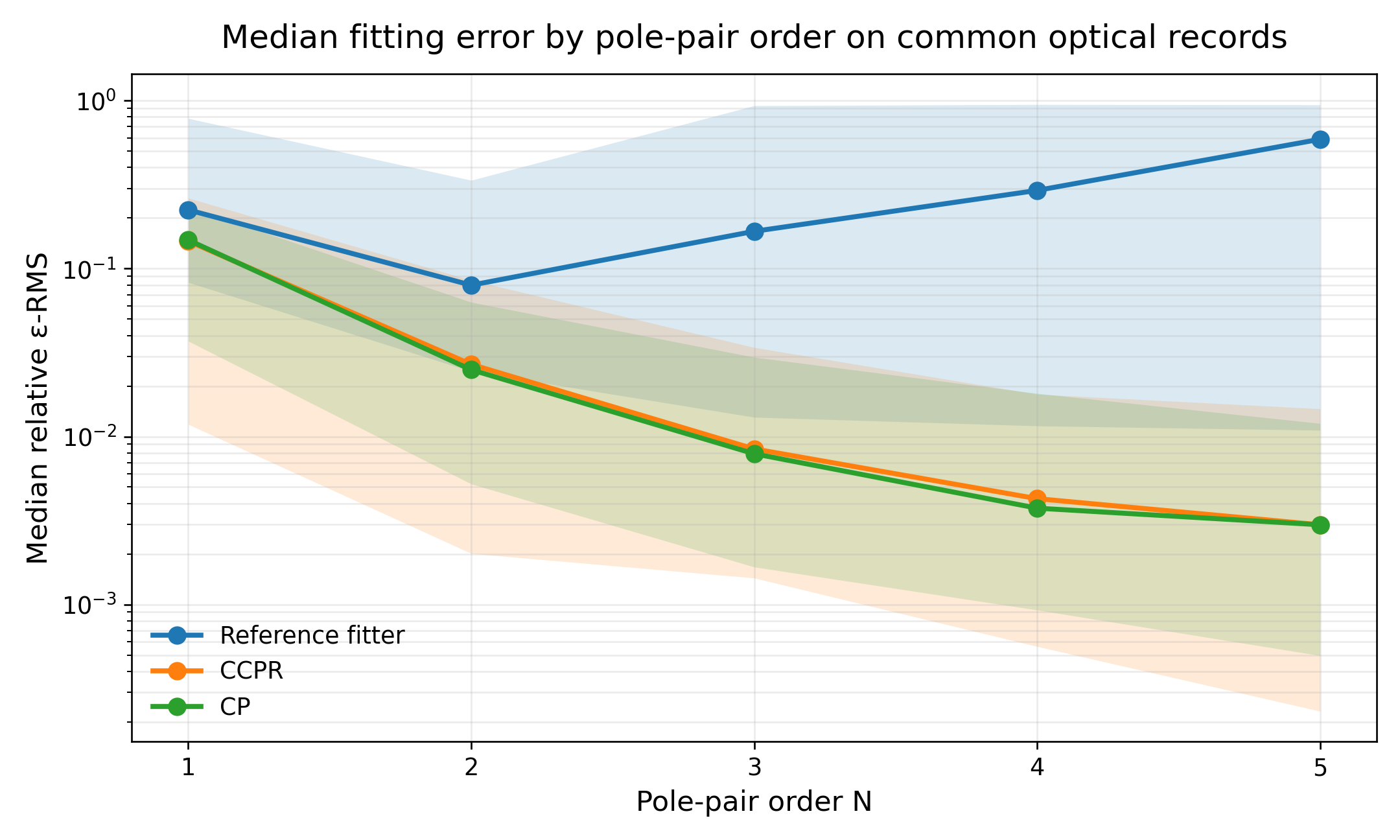
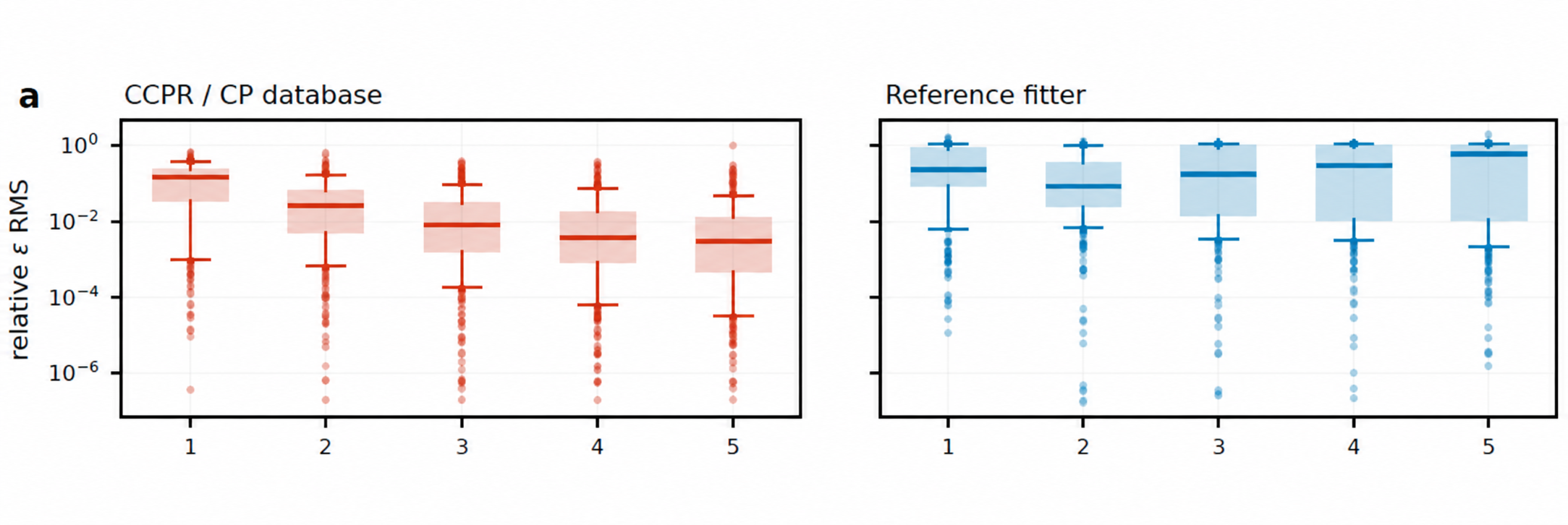
The figures below summarize the relative complex-permittivity RMS error as a function of pole-pair order N on common optical records. The reference curve corresponds to an external on-demand pole-residue fitter, while CCPR and CP denote the database fitting families. Increasing N generally reduces the median error of the released CCPR and CP candidates, but the final recommendation is selected using both fitting accuracy and physical/numerical readiness.
Scope of use
Use this database when you need an already-audited dispersive material model for FDTD within the fitted visible–near-IR interval. Each record is fitted independently over the wavelength range supported by its own experimental data, usually within 0.3–1.1 µm or a subset of that range.
These models should not be treated as universal optical constants outside the fitted interval. Extrapolation can be inaccurate even when a model is causal, passive, and usable in the centered-ADE update. Users should inspect the online n/k and permittivity plots before using a model in production simulations.
Release statistics
| Candidate model rows | 6075 |
|---|---|
| Exported centered-ADE-ready model files | 3929 |
| Records with final recommendation | 396 / 405 |
| Records without recommended export | 9 / 405 |
| Full fitted 0.3–1.1 µm records | 279 / 405 |
| Partial-window records | 126 / 405 |
How ε-RMS is computed
Experimental optical constants are converted to εexp(λ) = [n(λ) + i k(λ)]2 and compared with the fitted εfit(λ) on the same fitting grid. The reported error is ε-RMS = sqrt(mean(|εfit − εexp|2 / (|εexp|2 + 10−12))).
| Recommended ε-RMS ≤ 10−3 | 59 / 396 |
|---|---|
| Recommended ε-RMS ≤ 5×10⁻³ | 241 / 396 |
| Recommended ε-RMS ≤ 10−2 | 281 / 396 |
| Recommended ε-RMS > 5×10⁻² | 39 / 396 |
These statistics use the final recommended model for each recommended record, so the denominator is 396 rather than the 3929 exported model files.
Questions, corrections, or suggestions: jinyoulu@ntu.edu.tw.
THANK YOU ALL!
- My beloved family
Thank you for all the supports during my postdoc career:
- Prof. TieJun Zhang, Khalifa University
- Prof. Daniel Choi, Khalifa University
- Prof. Matteo Chiesa, Khalifa University
- Prof. Ibraheem Almansouri, Abu Dhabi Future Energy Company
- Prof. Nicholas Xuanlai Fang, MIT
- Prof. Gang Chen, MIT
- Prof. Thomas C.-K, Yang, National Taipei University of Technology
- Prof. Weilin Yang, Jiangnan University
- Dr. Aikifa Raza, Khalifa University
- Dr. Hongxia Li, Khalifa University
- Dr. Srinivasa Reddy Tamalampudi, Khalifa University
- Dr. Nitul S Rajput, Khalifa University
- Dr. Shih-Wen Chen, National Taipei University of Technology
- Mr. Boulos Fakes, Khalifa University
- Mr. Abdulrahman Al-Hagri, Khalifa University
- Ms Chia-Yun Lai, Khalifa University
- Ms Mariam Ali Almahri, Khalifa University
- Mr. Harry Apostoleris, Khalifa University
- Mr. Yu-Cheng Chiou, UiT
- Mr. Cheng-Hsiang Chiu, UiT
- Ms Shabnam Ranny, Aspen Heights School
Thank you for the supports during my PhD:
- Prof. Yuan-Huei Chang, my PhD advisor
- Prof. Chi-Te Liang, Nationa Taiwan University
- Prof. Yang-Fang Chen, National Taiwan University
- Prof. Kuo-PIn Chiu, CYCU
- Prof. Chih-Ming Wang, NCU
- Prof. Din-Pin Tsai, Academia Sinica
- Prof. Wei Chih Liu, NTNU
- Dr. Husan-Yi Chao, SCIENTEK
- Dr. Hung-Ji Huang, Instrument Technology Research Center
- Dr. Ryan Cheng, senior member at my lab
Thank you for the supports during my career at TSMC:
- Dr. Lu-Hsing Tsai, TSMC
- Dr. Chung-Liang Cheng, TSMC
- Mr. Wilson Liu, ASML
- Ms. Ya-Ling Huang, TSMC
- Mr. Che-Chih Hsu, TSMC
- Dr. San-Yi Huang, TSMC
- Dr. Ju-Ying Chen, TSMC
Teaching & Technical Tutorials
This section collects selected teaching modules and technical tutorials in computational mechanics, computational electromagnetics, scientific computing, and materials modeling.
Computational Mechanics
Computational Structural Mechanics
Analytical modeling, CLT, COMSOL simulation, and simulation-oriented structural notes.
Computational Electromagnetics
Computational Electromagnetics
TMM, FDTD, wave propagation, scattering, and simulation-oriented electromagnetic notes.
Multilayer Transfer Matrix Calculations
Fresnel coefficients, transfer matrices, multilayer reflectance and transmittance.
Scientific Computing
CUDA Tutorial for Scientific Computing
GPU computing, kernel design, memory access, and performance-oriented numerical workflows.
Electronic Structure and Materials Modeling
QuantumEspresso Si Bandstructure
Plane-wave DFT workflow, Brillouin-zone path, and basic electronic-structure analysis.
Experimental and Characterization Methods
Filmmetric F40 Equipment Measurements
Thickness measurement, optical fitting, and thin-film characterization basics.